Filling
Best for smaller cavities or chips when the tooth walls and cusps are still strong enough to support the restoration.

Dental Overlays
Broader tooth protection for cracked, weakened, or heavily restored teeth — planned with a conservative restorative philosophy.
Broader Tooth Reinforcement
A dental overlay can protect a broader chewing surface when a tooth has multiple weakened cusps, large old dental work, cracks, worn areas, or structural loss that needs more reinforcement. Dr. Steven Nguyen evaluates whether an overlay can protect the tooth while preserving healthy structure — or whether a full crown is the better long-term option.
Book a consultation
Dental Overlays
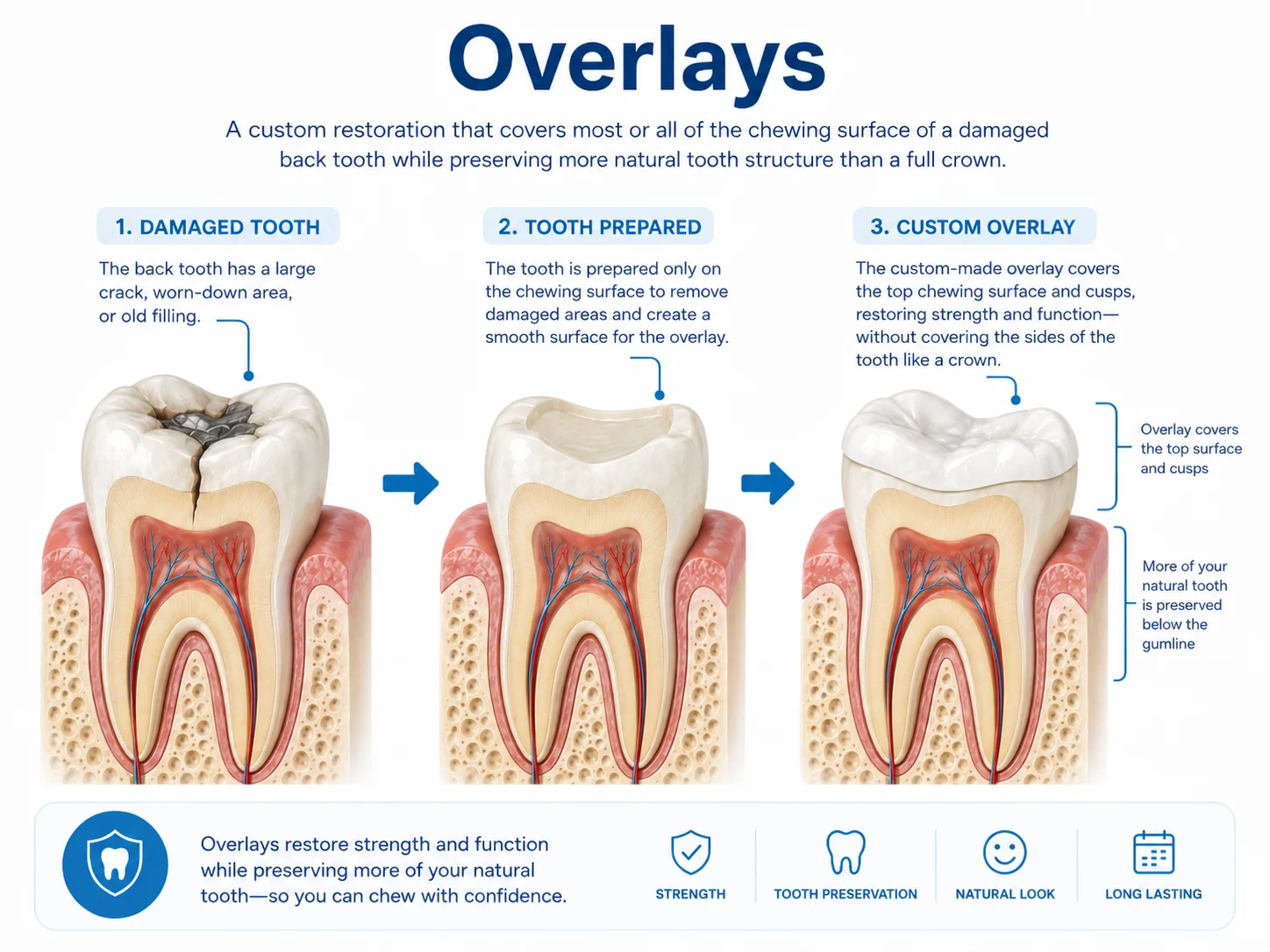
An overlay can cover broader chewing-surface damage and weakened cusps while preserving more natural tooth than a full crown in select cases.
Conservative Coverage
Some teeth are too compromised for another large filling but may not need every surface reduced for a full crown. In those cases, an overlay may provide broader support across the chewing surface while still respecting healthy tooth structure.
This is where Dr. Steven’s biomimetic-inspired and adhesive dentistry training matters. The goal is to understand how the tooth is failing, prepare it carefully, bond predictably, and choose the level of coverage that gives the tooth a realistic long-term prognosis.
When It Helps
Overlays are considered when the tooth needs broader support than a filling or smaller onlay can provide, but a crown is not automatically the only option.
When the biting surface has lost significant support from decay, fracture, wear, or old dental work, an overlay may help protect more of the tooth while preserving healthy structure where possible.
If several cusps are thin, cracked, or unsupported, a restoration that covers more of the chewing surface may be needed to reduce the risk of further fracture.
Some cracks need a restoration that holds the tooth together more broadly. Dr. Steven evaluates symptoms, bite forces, photos, X-rays, and clinical findings before recommending the level of coverage.
In select cases, an overlay can provide broader protection than an onlay while still preserving more tooth structure than a full crown. It is not always the answer, but it can be the right middle ground.
Cracked & Weakened Teeth
Patients are sometimes surprised when a tooth with a large filling or visible crack needs reinforcement even if it is not painful. Pain is not the only sign of structural risk. Photos, digital scans, X-rays, bite analysis, and clinical testing help Dr. Steven show what is happening and explain whether a filling, onlay, overlay, or crown is the most appropriate path.
Ask about conservative options
Treatment Comparison
These categories are not about “better” or “worse.” They describe how much support the tooth needs after damage, decay, cracks, or old restorations are evaluated.
Best for smaller cavities or chips when the tooth walls and cusps are still strong enough to support the restoration.
Covers part of the chewing surface and usually one or more weakened cusps when the tooth needs more support than a filling.
Covers broader chewing-surface areas or multiple cusps when the tooth needs more reinforcement but may not require full crown coverage.
Covers the full visible part of the tooth when structural loss, cracks, or prognosis make full coverage the better long-term option.
Clear Answers for Patients
These questions often come up when a tooth has a large old filling, crack, or chewing-surface breakdown.
A dental overlay is a custom restoration that covers a larger portion of the chewing surface of a tooth. It can protect multiple weakened cusps or broader areas of breakdown while preserving healthy tooth structure when the tooth safely allows it.
An onlay usually reinforces a smaller portion of the chewing surface and one or more cusps. An overlay generally provides broader coverage when more of the chewing surface or multiple cusps need protection.
It can be in select cases. A crown covers the full visible tooth, while an overlay may protect the weakened chewing surface without removing as much healthy tooth structure. Some teeth still need crowns, especially when cracks or structural loss are more severe.
A tooth can be structurally weak even without pain. Large old fillings, cracks, undermined cusps, or worn chewing surfaces can increase fracture risk. Dr. Steven uses photos, scans, X-rays, and exam findings to explain why reinforcement may be recommended.
Further Reading
FAQs
A dental overlay is a custom restoration that covers a larger portion of the chewing surface of a tooth. It can protect multiple weakened cusps or broader areas of breakdown while preserving healthy tooth structure when the tooth safely allows it.
An onlay usually reinforces a smaller portion of the chewing surface and one or more cusps. An overlay generally provides broader coverage when more of the chewing surface or multiple cusps need protection.
It can be in select cases. A crown covers the full visible tooth, while an overlay may protect the weakened chewing surface without removing as much healthy tooth structure. Some teeth still need crowns, especially when cracks or structural loss are more severe.
A tooth can be structurally weak even without pain. Large old fillings, cracks, undermined cusps, or worn chewing surfaces can increase fracture risk. Dr. Steven uses photos, scans, X-rays, and exam findings to explain why reinforcement may be recommended.
Overlays can be used in biomimetic-inspired restorative planning because they may preserve healthy tooth structure while reinforcing weakened areas. At MDRN, the broader goal is conservative, long-term restorative care rather than treating biomimetic dentistry as a rigid label.
Overlay longevity depends on the tooth, material, bonding conditions, bite forces, home care, and maintenance. They are designed as long-term restorations, but no dental restoration has a guaranteed lifespan.
An overlay can help protect and reinforce a weakened tooth, but it cannot guarantee that a tooth will never need root canal treatment. Teeth with deep decay, cracks, or prior trauma may still develop symptoms that require additional care.
The choice depends on remaining tooth structure, crack depth and direction, symptoms, X-ray findings, bite forces, and long-term prognosis. Dr. Steven will explain why an overlay or crown is recommended for your specific tooth.
Clinical Review
Dr. Nguyen is the founder and lead dentist at MDRN Dental Studio in McKinney, TX. He reviews patient education for accuracy, clarity, and conservative treatment planning.
Information on dental overlays and tooth reinforcement is written to help patients understand options before a visit, not to replace a dental exam. Recommendations still depend on X-rays or 3D imaging when appropriate, photos, gum health, bite forces, symptoms, medical history, and your goals.
Dental Overlays in McKinney
If you have a cracked tooth, large failing filling, worn chewing surface, or weakened cusps, Dr. Steven can help you understand whether an overlay, onlay, crown, or another conservative restoration is the best fit. Call (469) 712-2046 or book online.
6451 W University Dr, Ste 300 · McKinney, TX 75071